Petroleum is the fuel behind much of modern life. It moves cars, trucks, ships and aircraft. It supports factories, power systems, petrochemicals, plastics, fertilizers, road construction and global trade. Even as renewable energy is growing, petroleum still remains one of the most important resources in the world economy.
For this 2026 ranking, the figures are based on the latest complete annual country-wise data for petroleum and other liquids, measured in million barrels per day. This includes crude oil and related liquid fuels, not just refined products. The latest EIA-based annual data places the top 10 countries at about 76.28 million barrels per day out of global output of 103.32 million barrels per day.
Now let’s check out the top 10 largest producers of petroleum in the world in 2026.
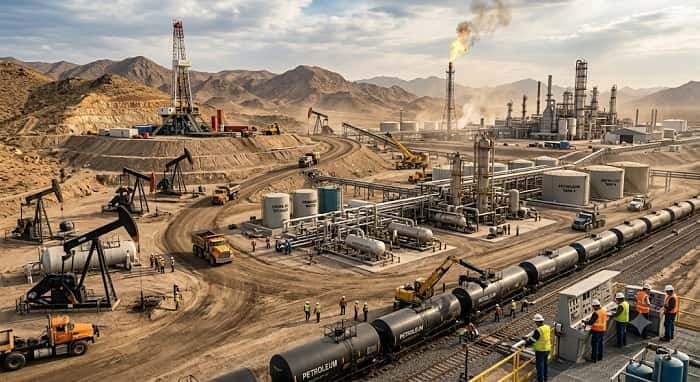
1. United States – Around 22.84 Million Barrels Per Day
The United States leads the world because of its huge shale oil production and advanced drilling technology.
The United States is the largest petroleum producer in the world. Texas, New Mexico, North Dakota, Alaska and the Gulf region are major production centres. The growth of shale oil, especially from the Permian Basin, has changed the global oil market and made the U.S. far more powerful in energy supply. Its production is far ahead of any other country.
2. Saudi Arabia – Around 10.88 Million Barrels Per Day
Saudi Arabia remains the strongest OPEC producer and one of the most influential oil exporters.
Saudi Arabia ranks second among the largest petroleum producers. The country has some of the world’s biggest oil fields, including the famous Ghawar field. Petroleum is the backbone of its economy, exports and government revenue. Because of its huge reserves and export power, Saudi Arabia plays a major role in global oil prices.
3. Russia – Around 10.53 Million Barrels Per Day
Russia is a petroleum giant with large reserves spread across Siberia and other energy-rich regions.
Russia takes third place in global petroleum production. Its important oil-producing regions include West Siberia, the Volga-Urals region and areas near the Caspian Sea. Russian oil is important for both domestic use and exports. Despite sanctions and changing trade routes, Russia remains one of the world’s biggest energy suppliers.
4. Canada – Around 6.00 Million Barrels Per Day
Canada stands strong because of its massive oil sands resources, especially in Alberta.
Canada ranks fourth in the world. Alberta is the heart of Canadian petroleum production, mainly because of its oil sands. Canada exports a large share of its oil, especially to the United States. The country’s petroleum sector is also supported by pipelines, refineries and long-term energy investments.
5. China – Around 5.33 Million Barrels Per Day
China produces a large amount of petroleum, but its huge demand still keeps it dependent on imports.
China is the fifth-largest petroleum producer in the world. Major production areas include Daqing, Shengli, Changqing and offshore fields. China’s domestic production is important for energy security, but its economy consumes far more oil than it produces. That is why China remains one of the world’s biggest oil importers.
6. Iran – Around 4.62 Million Barrels Per Day
Iran has huge petroleum reserves and remains one of the most important oil producers in the Middle East.
Iran ranks sixth in global petroleum production. Its oil sector is based around major fields in Khuzestan and other western and southern regions. Petroleum is central to Iran’s economy, exports and energy policy. However, sanctions, investment limits and geopolitical pressure often affect its production and trade.
7. United Arab Emirates – Around 4.51 Million Barrels Per Day
The UAE is a major petroleum producer with Abu Dhabi holding most of its oil strength.
The United Arab Emirates ranks seventh in the world. Abu Dhabi is the main centre of oil production, with ADNOC playing a key role in the sector. The UAE has invested heavily in increasing production capacity and modernizing its energy industry. Oil continues to support exports, revenue and industrial growth.
8. Iraq – Around 4.50 Million Barrels Per Day
Iraq has some of the world’s richest oil fields and depends heavily on petroleum revenue.
Iraq stands eighth among the largest petroleum producers. Major oil fields are located in southern Iraq, including Rumaila, West Qurna and Zubair. Petroleum is the main source of government income and export earnings for the country. With better infrastructure and stability, Iraq has the potential to raise production further.
9. Brazil – Around 4.28 Million Barrels Per Day
Brazil is rising fast because of its deepwater offshore oil fields.
Brazil ranks ninth in global petroleum production. Its biggest strength comes from offshore pre-salt oil fields in the Atlantic Ocean. Petrobras is the leading company behind much of Brazil’s oil growth. The country has become one of the most important non-OPEC producers and is expected to remain a strong force in future oil supply.
10. Kuwait – Around 2.78 Million Barrels Per Day
Kuwait completes the top 10 with large reserves and a highly oil-dependent economy.
Kuwait is one of the oldest and most important oil producers in the Gulf region. Petroleum supports a major share of its GDP, exports and government revenue. The country has large reserves and continues to work on expanding production capacity. Even with challenges, Kuwait remains a key name in global petroleum supply.
Final Words
Petroleum production is still dominated by a few powerful countries. The United States leads by a wide margin, followed by Saudi Arabia and Russia. Canada, China, Iran, the UAE, Iraq, Brazil and Kuwait complete the top 10. Together, these countries shape global fuel supply, oil prices, energy security and the movement of the world economy.