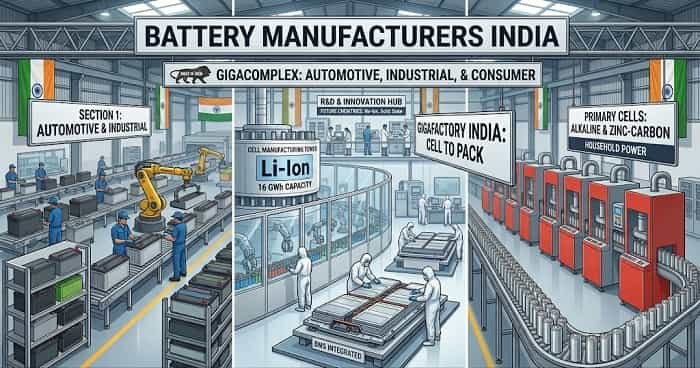
Batteries are now at the centre of India’s energy story. They are used in cars, bikes, trucks, inverters, UPS systems, telecom towers, solar projects, electric vehicles, railways, defence systems and data centres. Earlier, the Indian battery market was mostly about lead-acid batteries for vehicles and home backup. Now the industry is moving toward lithium-ion cells, battery packs, energy storage systems and EV batteries.
India’s battery manufacturing industry has two sides. One side has established lead-acid battery giants with strong brands and huge distribution networks. The other side has new-age lithium-ion and advanced chemistry cell players building future capacity. For this 2026 list, the ranking is based on manufacturing strength, product range, market presence, brand trust, technology shift, industrial use and future importance.
Now let’s check out the top 10 battery manufacturing companies in India in 2026.
1. Exide Industries
Exide Industries is India’s strongest battery manufacturing company with deep presence in automotive, inverter, industrial and solar batteries.
Exide is one of the oldest and most trusted names in India’s battery market. The company makes batteries for cars, two-wheelers, three-wheelers, e-rickshaws, inverters, UPS systems, gensets, solar applications, telecom, railways, infrastructure and even submarine use. Its official product list covers automotive batteries, inverter batteries, institutional UPS batteries, solar batteries, infrastructure batteries, battery energy storage solutions and submarine batteries.
Exide is also moving into lithium-ion cell manufacturing through Exide Energy Solutions. Its planned 12 GWh lithium-ion cell plant in Karnataka makes it important not only in traditional batteries but also in India’s EV and energy-storage future. This mix of old strength and new technology keeps Exide at the top.
2. Amara Raja Energy & Mobility
Amara Raja is one of India’s biggest battery makers and the company behind the popular Amaron brand.
Amara Raja Energy & Mobility is a major player in automotive and industrial batteries. The company serves retail customers as well as OEMs, and its batteries are used in cars, two-wheelers, telecom towers, UPS systems, railways, motive applications, solar systems and defence. The company says it exports to more than 70 countries and is one of the largest manufacturers of lead-acid batteries for industrial and automotive applications in India.
Amara Raja is also building a strong lithium-ion future. Its advanced cell technology division works on Li-ion cells, battery packs and charging solutions, and the company is developing a gigafactory in Hyderabad. Its deal with Gotion gives it access to LFP cell technology, making it one of India’s most important future battery companies.
3. HBL Engineering
HBL Engineering is a specialist battery manufacturer with strong presence in railways, defence, industrial and energy storage applications.
HBL Engineering, earlier known as HBL Power Systems, is not a mass-market household battery brand like Exide or Amaron, but it is very important in specialised battery segments. The company works in batteries, electronics, e-mobility, defence and battery energy storage systems. Its official site mentions battery business units and lithium-ion based containerised BESS solutions for rail, defence and industrial applications.
HBL’s strength is in critical and technical applications. Railways, defence, industrial backup systems and specialised power projects need reliable batteries with long life and safe performance. This is where HBL has built its reputation. In India’s battery industry, it is one of the strongest names outside the regular car and inverter battery market.
4. Luminous Power Technologies
Luminous is one of India’s most trusted names in inverter batteries and home power backup solutions.
Luminous Power Technologies is widely known for inverters, inverter batteries, UPS systems and solar solutions. The company has a strong presence in Indian homes, shops and small offices where power backup is still a major need. Its official site mentions seven manufacturing units, more than 100 million customers, over 300 products and a dealer network of more than 50,000.
Luminous is important because batteries for home backup remain a huge market in India. In many towns and semi-urban areas, inverter batteries are still essential during power cuts. Luminous has built its name on reliability, easy availability and strong service support. That keeps it among the top battery manufacturing companies in India.
5. Livguard
Livguard is a fast-growing energy storage brand with strong presence in inverter, automotive and solar battery segments.
Livguard has become a visible name in India’s battery and power backup market. The company offers home inverters, inverter batteries, automotive batteries and solar solutions. Its official site mentions automotive batteries, inverter batteries with 3D grid technology, solar rooftop solutions and availability across more than 21,000 pincodes.
Livguard’s strength is its modern branding and wide consumer reach. It is especially popular in the home power backup and automotive battery market. As more households move toward reliable inverter systems, solar backup and better battery performance, Livguard continues to gain space among India’s important battery companies.
6. Okaya Power
Okaya Power is a major Indian battery brand known for inverter, solar and e-rickshaw batteries.
Okaya has a long presence in India’s power backup and energy solutions market. The company offers inverter batteries, e-rickshaw batteries, solar batteries, home UPS systems, solar PCUs, on-grid inverters and solar panels. Its official site describes Okaya as a brand with more than four decades of legacy and mentions in-house manufacturing and ISO-certified smart facilities.
Okaya is especially important in the inverter battery, solar battery and e-rickshaw battery segments. E-rickshaws are a big part of India’s low-cost electric mobility market, and battery demand in this segment remains strong. Okaya’s mix of backup power and mobility products makes it a valuable name in the Indian battery industry.
7. Tata Green Batteries
Tata Green Batteries is a strong automotive and inverter battery brand backed by Tata AutoComp and GS Yuasa technology.
Tata Green Batteries has built its position in automotive batteries, inverter batteries, genset batteries, commercial vehicle batteries, tractor batteries, two-wheeler batteries and e-rickshaw batteries. Its official product list includes automotive batteries, power backup products and industrial batteries.
The brand is important because it combines Tata’s Indian market strength with Japanese battery technology from GS Yuasa. Tata Green says the company was formed through a strategic partnership between Tata AutoComp and GS Yuasa International, bringing automotive experience and battery technology together. For customers who want a trusted car or bike battery brand, Tata Green remains a strong option.
8. AMCO Batteries
AMCO Batteries is one of India’s older battery manufacturers with strength in automotive, inverter, UPS and genset batteries.
AMCO Batteries is headquartered in Chennai and belongs to the Amalgamations Group. The company’s product profile includes automotive batteries, inverter batteries, genset batteries and UPS batteries. It has also been known for supplying two-wheeler batteries to major vehicle companies and four-wheeler batteries to tractor and commercial vehicle customers.
AMCO may not be as visible in advertising as some newer battery brands, but it has deep industry experience. Its long history and OEM connections make it important in India’s automotive battery ecosystem. For two-wheelers, tractors, UPS systems and backup applications, AMCO continues to be a relevant manufacturer.
9. Ola Cell Technologies / Ola Electric
Ola Cell Technologies is important because it represents India’s push into lithium-ion cell manufacturing for electric vehicles.
Ola is better known as an electric scooter company, but its battery cell ambition makes it important in this list. India’s advanced battery cell manufacturing has been slow under the ACC PLI scheme, but reports said Ola Electric had commissioned 1.4 GWh of capacity by October 2025, making it one of the first visible cell manufacturers under the scheme.
Ola’s role is different from Exide or Luminous. It is not a traditional battery replacement brand. Its importance lies in EV battery cells, localisation and reducing dependence on imported cells. If Ola’s gigafactory scale improves, it can become one of the most important battery manufacturing names in India’s EV future.
10. Reliance New Energy
Reliance New Energy completes the list as a future-focused battery manufacturing company with large energy storage ambitions.
Reliance New Energy is not a conventional retail battery brand, but it is one of the most important names in India’s future battery manufacturing race. The company is working on a battery storage manufacturing ecosystem covering cells to containerised energy storage systems. In January 2026, Reliance said its battery manufacturing plans were unchanged and progressing according to target timelines.
Reliance matters because India will need large-scale batteries for renewable energy storage, grid balancing and electric mobility. If the company successfully builds its planned battery ecosystem, it can become a major force in lithium-ion cells and energy storage systems. That future potential gives it a place in the top 10 list.
Final Words
India’s battery manufacturing industry in 2026 is led by established names such as Exide, Amara Raja, HBL, Luminous, Livguard, Okaya, Tata Green and AMCO. At the same time, Ola Cell Technologies and Reliance New Energy show where the industry is heading next: lithium-ion cells, EV batteries and large-scale energy storage. As electric vehicles, solar power and backup power demand continue to grow, battery manufacturers will remain one of the most important parts of India’s energy and mobility future.