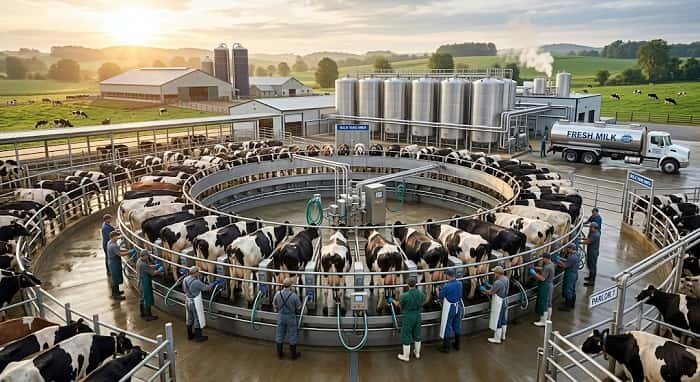
Milk has a simple look, but its journey is powerful. It starts in dairy farms before sunrise, moves through collection centres, enters chilling plants, reaches factories, and finally becomes fresh milk, curd, butter, paneer, cheese, ghee, yoghurt, sweets and baby food. For many families, milk is the first food of the morning and the last warm drink of the night.
In 2026, global milk production is led by countries with huge livestock populations, strong dairy farming systems and rising domestic demand. This ranking uses individual countries, not the European Union as one combined bloc. The figures are rounded and based on the latest available official and 2025/26 industry estimates. FAO names India, the United States, Pakistan, China and Brazil as the world’s leading milk producers, while OECD-FAO says world milk output reached about 1,005 million tonnes in 2025, with India at 255 million tonnes and Pakistan at 69 million tonnes.
Now let’s check out the top 10 largest producers of milk in the world in 2026.
1. India – Around 255 Million Metric Tons
India is the world’s dairy giant because milk is part of daily food, rural income and the cooperative economy.
India ranks first among the largest milk producers in the world. The country’s dairy strength comes from both cow and buffalo milk. Uttar Pradesh, Rajasthan, Madhya Pradesh, Gujarat, Maharashtra, Andhra Pradesh and Punjab are major milk-producing states. Milk is used widely in tea, curd, paneer, ghee, sweets, butter and many household foods. India’s huge dairy farmer base and cooperative model make it unmatched in total milk production.
2. United States – Around 106 Million Metric Tons
The United States produces milk with high productivity, advanced farms and a strong dairy processing industry.
The United States stands second in the world. California, Wisconsin, Idaho, Texas and New York are among its leading dairy states. American dairy farming is known for large farms, high-yielding cows, technology, feed management and strong processing capacity. USDA’s 2026 forecast places U.S. cow milk production at about 106.19 million tonnes.
3. Pakistan – Around 69 Million Metric Tons
Pakistan’s milk production is huge because dairy animals are deeply connected with rural households and daily diets.
Pakistan ranks third in global milk production. Punjab and Sindh are the main dairy regions. Milk is used daily in tea, lassi, yoghurt, butter, desserts and traditional foods. Like India, Pakistan’s dairy sector depends heavily on small farmers and buffalo milk. Rising population and strong domestic consumption keep the country among the world’s biggest milk producers.
4. China – Around 41.5 Million Metric Tons
China’s milk industry has grown quickly because of urban demand, packaged dairy products and better farm systems.
China holds fourth place in the world. Inner Mongolia, Heilongjiang, Hebei and Xinjiang are important dairy regions. Milk consumption has increased in cities, especially through packaged milk, yoghurt, infant formula and dairy drinks. China’s production is large, but demand is also high, so the country continues to remain important in both production and imports.
5. Brazil – Around 35–36 Million Metric Tons
Brazil is Latin America’s biggest dairy power, supported by a large cattle base and a growing domestic market.
Brazil ranks fifth among the largest milk-producing countries. Minas Gerais, Paraná, Rio Grande do Sul, Goiás and São Paulo are major dairy regions. Brazil’s dairy sector serves a huge local market for fluid milk, cheese, yoghurt and other products. Industry reports note that Brazilian milk production has remained close to the 35 million tonne level in recent years, with gradual recovery and modernization.
6. Germany – Around 32–33 Million Metric Tons
Germany is Europe’s strongest individual milk-producing country and a major dairy processing hub.
Germany stands sixth in the world and first within the European Union as an individual country. Bavaria, Lower Saxony and North Rhine-Westphalia are important dairy areas. German milk supports cheese, butter, yoghurt, drinking milk and export-oriented dairy products. Official European statistics place Germany’s cows’ milk output around 32.4 million tonnes in 2023, keeping it among the world leaders.
7. Russia – Around 32–33 Million Metric Tons
Russia remains a major milk producer because of its large land area, growing dairy investments and strong local demand.
Russia ranks seventh in global milk production. Dairy farming is spread across regions such as Tatarstan, Bashkortostan, Udmurtia, Krasnodar and Moscow region. The country has been working to improve milk yields, modernize farms and reduce dependence on imported dairy products. Domestic consumption of milk, sour cream, cheese and butter keeps the industry important.
8. France – Around 24–25 Million Metric Tons
France is not only a milk producer; it is also one of the world’s great cheese and dairy culture countries.
France ranks eighth among the largest milk producers. Brittany, Normandy, Pays de la Loire and Auvergne-Rhône-Alpes are key dairy regions. French milk is deeply connected with cheese, butter, cream and yoghurt production. France produced about 23.5 million tonnes of cows’ milk in 2023, making it one of Europe’s largest dairy nations.
9. New Zealand – Around 21.8 Million Metric Tons
New Zealand produces less milk than giants like India or the U.S., but it is one of the most export-focused dairy countries.
New Zealand ranks ninth in this list. Dairy farming is especially strong in Waikato, Canterbury, Taranaki and Southland. The country has a small population, so much of its milk is converted into milk powder, butter, cheese and other export products. USDA forecasts New Zealand milk production at about 21.8 million tonnes in 2026.
10. Turkey – Around 21.3 Million Metric Tons
Turkey completes the top 10 with strong raw milk production and a large domestic dairy market.
Turkey, officially Türkiye, is another major milk producer. Dairy farming is spread across regions such as Konya, Izmir, Balıkesir, Erzurum and Aydın. Milk is used in yoghurt, ayran, cheese, butter and traditional sweets. TÜİK data reported Turkey’s raw milk production at about 21.37 million tonnes in 2025, keeping it close to the world’s top 10.
Final Words
Milk is more than a drink. It is nutrition, rural employment, food processing and daily comfort. India leads the world by a huge margin, followed by the United States, Pakistan, China and Brazil. Germany, Russia, France, New Zealand and Turkey complete the group of major dairy producers. In 2026, these countries continue to shape the world’s dairy supply and keep the global milk chain moving.