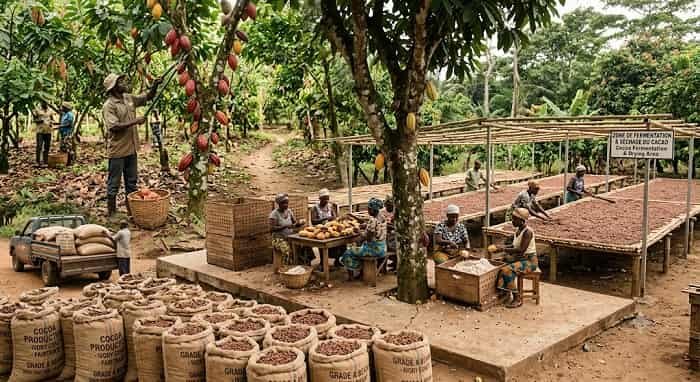
Cocoa has a small beginning but a rich ending. It starts as pods growing on cacao trees in warm tropical farms. Then the beans are harvested, fermented, dried, packed, shipped, roasted and finally turned into chocolate, cocoa powder, cocoa butter, drinks, bakery products and beauty-care ingredients. Every chocolate bar has a long farming story behind it.
In 2026, cocoa production is still led by West Africa, but Latin America is rising quickly, especially Ecuador. For this ranking, cocoa means cocoa bean production, not chocolate manufacturing or cocoa grinding. ICCO’s latest 2024/25 forecast placed world cocoa bean production near 4.84 million tonnes, while recent 2025/26 updates show Côte d’Ivoire expecting a recovery to around 2.0–2.1 million tonnes.
Now let’s check out the top 10 largest producers of cocoa in the world in 2026.
1. Côte d’Ivoire – Around 2.0 Million Metric Tons
Côte d’Ivoire is the world’s cocoa king and remains the main source of beans for global chocolate makers.
Côte d’Ivoire, also called Ivory Coast, is the largest cocoa producer in the world. Cocoa is the backbone of its rural economy and supports millions of farmers and workers. The country had faced lower crops in recent years due to weather, disease and ageing trees, but its regulator expected production to rise in the 2025/26 season.
2. Ghana – Around 600,000 Metric Tons
Ghana is famous for high-quality cocoa beans and remains one of the most respected names in the cocoa trade.
Ghana holds second place among the world’s largest cocoa producers. Cocoa is deeply linked with the country’s exports, farmer income and national economy. However, Ghana’s production has been under pressure because of swollen shoot disease, illegal mining, smuggling and old farms. ICCO’s 2024/25 forecast placed Ghana near 600,000 tonnes.
3. Ecuador – Around 480,000–650,000 Metric Tons
Ecuador is the fastest-rising cocoa producer and may challenge Ghana for the second position soon.
Ecuador is Latin America’s strongest cocoa producer. The country is known for fine-flavour cocoa and improving farm productivity. ICCO’s 2024/25 forecast placed Ecuador at around 480,000 tonnes, but industry leaders expect output to cross 650,000 tonnes in the 2026/27 season, which could push it closer to the global number two spot.
4. Nigeria – Around 350,000 Metric Tons
Nigeria is one of Africa’s major cocoa producers, with cocoa playing an important role in export earnings.
Nigeria ranks among the biggest cocoa-producing countries in the world. Cocoa is grown mainly in states such as Ondo, Cross River, Osun, Ogun, Ekiti and Edo. The country has strong potential because of its climate and farming base, but productivity, farm ageing and processing gaps remain challenges.
5. Cameroon – Around 320,000 Metric Tons
Cameroon remains a steady cocoa producer and an important part of West and Central Africa’s cocoa belt.
Cameroon is another key African cocoa producer. Cocoa farming is spread across regions with suitable rainfall and tropical conditions. The country supplies beans to international markets and also supports local processing. ICCO’s 2024/25 forecast kept Cameroon near 320,000 tonnes, showing its stable role in global cocoa supply.
6. Brazil – Around 210,000–300,000 Metric Tons
Brazil has a long cocoa history and is working to rebuild its position in global cocoa farming.
Brazil was once one of the world’s biggest cocoa producers, and it still remains an important name. Cocoa is grown mainly in Bahia and Pará. The country also has a large chocolate and food industry, so domestic demand is strong. ICCO’s 2024/25 forecast placed Brazil near 210,000 tonnes, while broader production tables show higher recent output depending on the dataset.
7. Indonesia – Around 200,000 Metric Tons
Indonesia is Asia’s leading cocoa producer, though its output has reduced from earlier peak years.
Indonesia is the biggest cocoa producer in Asia. Sulawesi has long been the heart of its cocoa farming. The country expanded strongly in past decades, but pests, ageing trees and lower yields have affected production. Still, Indonesia remains important for Asian cocoa supply and local processing.
8. Peru – Around 157,000 Metric Tons
Peru is known for quality cocoa, organic farming and strong growth in speciality markets.
Peru is one of South America’s important cocoa producers. Its cocoa is grown in regions such as San Martín, Junín, Cusco and Amazonas. Peruvian cocoa is valued for fine flavour, organic certification and export quality. It may not match West Africa in volume, but it has a strong identity in premium cocoa markets.
9. Dominican Republic – Around 57,000–80,000 Metric Tons
The Dominican Republic is a leading name in organic cocoa and fine-flavour cocoa exports.
The Dominican Republic is smaller in volume but very important in quality cocoa trade. Its cocoa sector is known for organic beans and premium chocolate supply chains. Many international buyers value Dominican cocoa for flavour, traceability and sustainability-focused farming.
10. Colombia – Around 68,000 Metric Tons
Colombia completes the list with growing recognition for fine cocoa and better-quality farming.
Colombia is a rising cocoa producer in Latin America. Cocoa is grown in regions such as Santander, Antioquia, Arauca and Huila. The country is known more for coffee, but cocoa is gaining attention as a valuable crop for farmers and exporters. Its fine-flavour cocoa gives it a good position in premium chocolate markets.
Final Words
Cocoa production in 2026 is still led by Côte d’Ivoire and Ghana, but the global map is changing. Ecuador is rising fast, while Nigeria, Cameroon, Brazil, Indonesia, Peru, the Dominican Republic and Colombia continue to support the world’s chocolate supply. Together, these countries keep cocoa moving from tropical farms to chocolate shelves across the world.