Gold has a different kind of power. It does not feed people like rice or wheat, and it does not run factories like coal, yet every country watches it closely. It sits in jewellery shops, bank vaults, investment portfolios, central bank reserves, electronic devices and wedding traditions. When markets shake, people look at gold. When currencies weaken, gold again comes into focus.
For this 2026 ranking, the latest USGS Mineral Commodity Summaries 2026 data has been used. It estimates world gold mine production at around 3,300 metric tons in 2025, with China, Russia, Australia, Canada and the United States as the top five producers. The country-wise production table also places Ghana, Mexico, Kazakhstan, Uzbekistan and Peru in the global top 10.
Now, with the golden map open, let’s count down the top 10 largest producers of gold in the world in 2026.
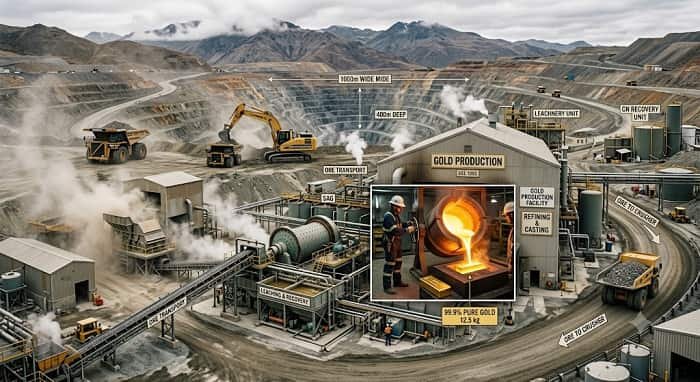
1. China – Around 380 Metric Tons
China stays at the top because it combines large mining output with massive domestic gold demand.
China is the world’s largest gold producer. Its gold mining activity is spread across provinces such as Shandong, Henan, Jiangxi, Inner Mongolia and Yunnan. Gold is important in China not only for jewellery and investment, but also for financial security and industrial use. Even with strict mining rules and environmental controls, China remains far ahead in total gold mine production.
2. Russia – Around 310 Metric Tons
Russia is a gold superpower with huge reserves and strong mining regions across Siberia and the Far East.
Russia ranks second among the largest gold producers in the world. Major gold-producing areas include Krasnoyarsk, Magadan, Amur, Yakutia and Irkutsk. The country has some of the world’s richest gold deposits and large-scale mining companies. Gold also plays an important role in Russia’s economy, exports and reserve strategy.
3. Australia – Around 280 Metric Tons
Australia’s gold strength comes from world-class mines, high reserves and advanced mining technology.
Australia takes third place in global gold production. Western Australia is the heart of the country’s gold industry, with famous mining areas such as Kalgoorlie and the Super Pit. Australia has a long gold-mining history, but it is still one of the most modern and productive gold producers. Strong exploration and large reserves keep it near the top.
4. Canada – Around 200 Metric Tons
Canada is one of the most trusted gold producers because of stable mining laws and rich mineral belts.
Canada ranks fourth in the world. Ontario, Quebec, British Columbia, Nunavut and the Northwest Territories are important gold-producing regions. Canadian gold mining is known for high standards, strong companies and major investment in exploration. The country’s gold industry supports exports, jobs and mining towns across several provinces.
5. United States – Around 160 Metric Tons
The United States remains a major gold producer, with Nevada leading the country’s output.
The United States stands fifth in global gold production. Nevada is the biggest gold-producing state, followed by Alaska and other western states. The U.S. has several large gold mines and modern processing facilities. Gold is used in jewellery, investment products, electronics and industrial applications, making it an important mineral for the American economy.
6. Ghana – Around 150 Metric Tons
Ghana is Africa’s leading gold producer and gold is one of its most valuable export earners.
Ghana ranks sixth among the world’s largest gold producers. The country is often called the “Gold Coast” because of its deep history with gold mining. Major mining areas include Ashanti, Western and Central regions. Gold supports Ghana’s economy through exports, employment and government revenue, though illegal mining and environmental concerns remain serious issues.
7. Mexico – Around 140 Metric Tons
Mexico is a major Latin American gold producer with a long mining tradition and rich mineral zones.
Mexico holds seventh place in the global ranking. Important gold-producing states include Sonora, Zacatecas, Chihuahua, Durango and Guerrero. The country has a strong mining history that goes back centuries. Today, gold mining in Mexico is supported by both large companies and mineral-rich regions that also produce silver, copper, lead and zinc.
8. Kazakhstan – Around 130 Metric Tons
Kazakhstan is becoming more important in global gold mining because of its strong reserves and growing output.
Kazakhstan ranks eighth among the largest gold producers. The country has rich deposits in regions such as Akmola, East Kazakhstan and Karaganda. Gold mining is an important part of Kazakhstan’s wider mineral economy, which also includes uranium, copper and coal. Its position between Europe and Asia gives it strategic value in mineral trade.
9. Uzbekistan – Around 130 Metric Tons
Uzbekistan stands out because it is home to some of the world’s most important gold mining operations.
Uzbekistan is another major Central Asian gold producer. The Muruntau mine, located in the Kyzylkum Desert, is one of the largest gold mines in the world. Gold is extremely important for Uzbekistan’s economy and exports. Even though its production is close to Kazakhstan’s, Uzbekistan has a special identity because of its massive individual mining assets.
10. Peru – Around 110 Metric Tons
Peru completes the top 10 with strong Andean mining regions and a major role in Latin American gold supply.
Peru ranks tenth among the largest gold producers in the world. Gold mining is active in regions such as Cajamarca, La Libertad, Arequipa and Madre de Dios. The country has both large-scale mines and smaller mining activity. Gold is one of Peru’s key mineral exports, along with copper, silver and zinc.
Final Words
Gold production is spread across Asia, Europe, North America, Africa, Oceania and Latin America, but a few countries dominate the supply. China leads the world, Russia and Australia follow closely, while Canada and the United States complete the top five. Ghana, Mexico, Kazakhstan, Uzbekistan and Peru add more strength to the global gold chain. In 2026, these countries remain the main engines behind the world’s mined gold supply.