Banana is one fruit that never feels far from daily life. It is eaten fresh, added to shakes, used in desserts, offered in temples, packed in lunch boxes, sold by street vendors and traded across oceans. Behind this simple yellow fruit, there is a huge farming network of tropical fields, small growers, exporters, cold chains and global buyers.
In 2026, banana production is mainly concentrated in Asia, Latin America and Africa. FAO notes that bananas are among the most produced, traded and consumed fruits globally, with India and China among the biggest producers for domestic consumption. APEDA’s March 2026 banana dashboard projects that the listed major countries account for nearly 70% of global banana production, with MY2026 output expected to grow by about 2% year-on-year.
Now let’s check out the top 10 largest producers of banana in the world in 2026.
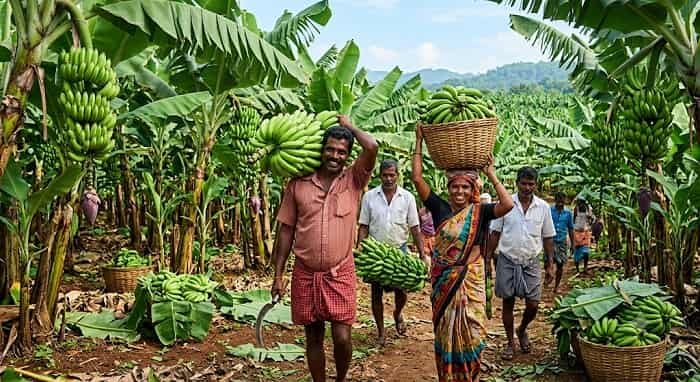
1. India – Around 40.3 Million Metric Tons
India is the world’s banana leader because of year-round cultivation, huge domestic demand and strong tropical farming zones.
India ranks first in banana production by a wide margin. Major producing states include Andhra Pradesh, Maharashtra, Tamil Nadu, Gujarat, Karnataka, Madhya Pradesh and Bihar. Bananas are consumed fresh, used in sweets, shakes, chips and religious offerings. India’s production is mostly consumed within the country, though exports are slowly growing.
2. China – Around 12.0 Million Metric Tons
China holds second place in global banana production. Important growing regions include Guangdong, Guangxi, Yunnan, Hainan and Fujian. Bananas are widely eaten as a fresh fruit and used in food processing. However, disease pressure and weather problems in southern regions can affect acreage and production.
3. Indonesia – Around 10.3 Million Metric Tons
Indonesia is the third-largest banana producer in the world. Bananas are grown across Java, Sumatra, Kalimantan, Sulawesi and other islands. The fruit is important for local food, snacks and household consumption. Indonesia produces many banana varieties, and most of its output is used domestically rather than exported.
4. Nigeria – Around 7.6 Million Metric Tons
Nigeria ranks fourth in the world. Banana and plantain-type crops are widely grown in humid southern and central regions. The crop supports small farmers, rural markets and household food needs. Nigeria’s production is mainly for local consumption, making it important for food security rather than global export trade.
5. Brazil – Around 7.1 Million Metric Tons
Brazil stands fifth among the largest banana-producing countries. Banana cultivation is common in São Paulo, Bahia, Minas Gerais, Santa Catarina, Pará and other states. The fruit is eaten daily by many Brazilian families and is also used in desserts and cooking. Brazil’s large population keeps most of its banana production within the country.
6. Ecuador – Around 6.6 Million Metric Tons
Ecuador ranks sixth in banana production. Its coastal lowlands offer excellent growing conditions for Cavendish bananas. The country has a highly developed export system, with bananas shipped to Europe, the United States, Russia, the Middle East and other markets. Banana exports are a major part of Ecuador’s agricultural economy.
7. Philippines – Around 6.1 Million Metric Tons
The Philippines holds seventh place in the 2026 ranking. Mindanao is the heart of its commercial banana industry, especially for Cavendish bananas. The country exports large volumes to Japan, China, South Korea and the Middle East. Banana farming also supports many workers and communities in the southern Philippines.
8. Angola – Around 5.1 Million Metric Tons
Angola ranks eighth among the world’s largest banana producers. The country’s tropical and subtropical conditions support banana cultivation in several regions. Bananas are important for food, rural income and local markets. Angola’s production has helped Africa become more visible in the global banana map.
9. Guatemala – Around 4.55 Million Metric Tons
Guatemala stands ninth in global banana production. Its humid tropical lowlands are suitable for large-scale Cavendish banana farming. The country is one of the leading banana exporters, especially to the United States and other international markets. Strong plantation systems and export infrastructure make Guatemala an important player in the global banana trade.
10. Tanzania – Around 3.82 Million Metric Tons
Tanzania is one of Africa’s key banana-producing countries. Bananas are grown in highland, lake zone and coastal areas. The crop is used both as a fruit and as a cooking staple in many communities. In several regions, banana farming is not just commercial agriculture; it is part of daily meals and rural culture.
Final Words
Banana production in 2026 is led clearly by India, followed by China and Indonesia. Nigeria, Brazil and Ecuador show the strength of Africa and Latin America, while the Philippines, Angola, Guatemala and Tanzania complete the top 10. Together, these countries keep one of the world’s most loved fruits available across homes, markets and export shelves.